

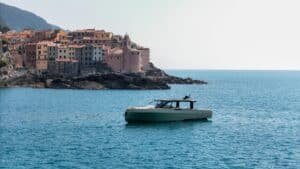

Two islands, fifteen minutes from Cannes. The same sea, the same horizon, and yet two opposite stories. One was used to make a man disappear for 34 years. The other trained major figures of the Christian world. What unites them is isolation, used here as an instrument of power, there as a life choice. And the sea that surrounds them, a silent witness to all that has happened on these two specks of rock for sixteen centuries.
Many discover the Lérins Islands by ferry from Cannes, for an afternoon. This is already a nice first approach, but it only shows a part of what these islands have to tell.
Sainte-Marguerite: The island chosen to make someone disappear
On April 30, 1687, a man arrived on Sainte-Marguerite Island. His name was not recorded. His face was never seen by anyone other than his jailer: Bénigne Dauvergne de Saint-Mars, a former musketeer who became a fortress governor. The prisoner would remain on the island for eleven years, until 1698, before being transferred to the Bastille, where he died on November 19, 1703. Total length of captivity: 34 years. Official identity: unknown to this day.
The island had been chosen for its isolation. Surrounded by water, visible from Cannes but inaccessible without a boat, it allowed for total surveillance with minimal staff. Minister Louvois's instructions to Saint-Mars are recorded in archival letters: only the governor personally brings the meals. Any attempt by the prisoner to reveal his identity must be punished by immediate death. The cell is equipped with several doors that close one after another. The doctor never sees his face. Neither does the confessor. The only regular outing: daily mass, at an altar placed directly facing the door, a window to God, but none to the world.
What is troubling from the start is the paradox of comfort. This prisoner, whose name must not be spoken, benefits from treatment that makes no sense in 17th-century jails: fine linen, carpets, a maintained fireplace, a guitar. An ordinary servant would not be treated this way. The question then naturally arises: who was this man that so many precautions were taken for him? And above all, why wasn't he simply eliminated?
The Legend: The King's Twin Brother
The most famous answer is also the least verifiable. Voltaire, the first to transform the affair into a legend in The Age of Louis XIV (1751), suggests that the prisoner was an illegitimate son of Louis XIII, of royal blood, too close to the throne to be executed, too dangerous to be left free. Alexandre Dumas goes further in The Viscount of Bragelonne (1847-1850): Louis XIV supposedly had a twin brother, born first and therefore the legitimate heir, hidden from birth to avoid a succession crisis. As an adult, this twin becomes the prisoner. Aramis, now a bishop, discovers the secret and attempts a coup by substituting the two brothers one night. D'Artagnan reinstates the true king. The twin takes back the mask for the rest of his life.
No contemporary source supports this thesis. Neither Voltaire nor Dumas had access to the archives. Both, on the other hand, had a keen sense of what makes a story unforgettable, and their version has survived all the historians' refutations because it answers the question everyone asks better than the truth: why so many precautions for an ordinary man?
What historians really think, and why it couldn't be killed
The most serious theory today centers on a man named Eustache Dauger, a valet, probably in the wrong place at the wrong time. In 1670, Louis XIV concluded with Charles II of England the Secret Treaty of Dover In exchange for French financial aid, the King of England promised to convert England to Catholicism. An undertaking that Charles II could not reveal to his own Parliament without risking his crown. If made public, this treaty would have triggered a major constitutional crisis in England and broken the Franco-English alliance. Dauger may have known about this secret, or others, related to the poisoning affair that was tearing the Court apart in those same years. He was not accused of any crime. He had probably done nothing. He knew, that's all. And knowing, in this specific case, was enough.
But why not simply eliminate him? The answer lies in one constraint: to execute a man, you need a trial. A trial implies witnesses, an indictment, a public hearing, and that's precisely what we can't afford here. To reveal why this man is dangerous is to reveal the secret itself. Life imprisonment, costly as it was, was the only option for a secret that could neither be spoken aloud nor allowed to die freely with its bearer. Silence for life was less dangerous than the truth.
The mask, the silver plate, and the final erasure
If his face was never seen, it's because the prisoner always appeared masked outside his cell, hence the origin of what would later be called the legend of the «Man in the Iron Mask.» But the reality is more nuanced.
The letters from Saint-Mars and contemporary testimonies systematically speak of a black velvet mask, with a steel chin strap that allows eating without removing it, worn only during transfers between prisons, never in the cell. It was Voltaire who popularized metal, Dumas who cast it into the collective imagination. Velvet became iron. Three centuries later, no one remembers the correction. Voltaire himself, despite his reputed skepticism, concludes in his Questions about the Encyclopedia : «I know of no fact either more extraordinary or better established.» Legend thrives precisely where facts are lacking.
In this total confinement, only one attempt at contact is known. It was circulated in Cannes while the protagonists were still alive: the prisoner is said to have engraved something on a silver plate with his knife, and to have thrown it out of the window towards a boat moored at the foot of the tower. A fisherman picked it up and brought it back to Saint-Mars. Saint-Mars asked him if he had read the inscription. The man replied that he couldn't read. Saint-Mars examines him at length, then releases him: «You are lucky you don't know how to read.» What the prisoner had engraved, we never knew. The plaque disappeared like the rest.
The rest, precisely, is where the affair definitively turns. On November 19, 1703, the prisoner died in the Bastille. He was buried under the false name «Marchioly,» his age incorrectly recorded. What followed has no precedent for an ordinary inmate: personal effects were burned, the cell walls were scraped and whitewashed, windows were replaced, and pages from the Bastille's register were torn out. Testimonies mention substances in the coffin to accelerate decomposition. This systematic erasure has become the best proof that the prisoner mattered. A valet would not have deserved such an effort. Saint-Mars, over 34 years and four successive prisons, was his only jailer, and died without speaking. Silence was his career. He ended as governor of the Bastille.
His cell is now accessible at the Museum of the Iron Mask and the Royal Fort. An empty room, nothing remains of the furniture, carpets, and tapestries that once furnished it. The barred windows overlook the Bay of Cannes. For eleven years, this man saw the coast, the boats, the movement of the world. Without ever being able to return.
Saint-Honorat: the island you choose to disappear on
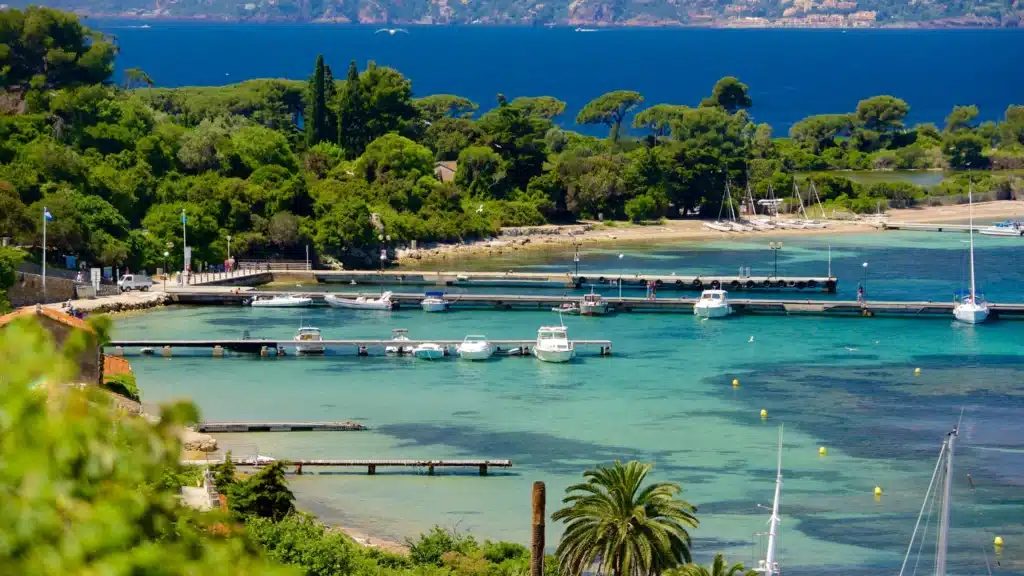
A ten-minute sail southwest brings you to the other island. The same sea, the same isolation, but a completely inverted logic. Where Sainte-Marguerite served to imprison men against their will, Saint-Honorat has always been a chosen refuge. And it is much older: the Abbey of Lérins was founded around 405-410 AD, six centuries before Cannes existed, twelve centuries before the first Festival. What this island has endured over sixteen centuries resembles less a story than a series of trials: miraculous foundation, intellectual radiance, massacres, fortification, occupation, rebirth. A community that refused to disappear, time and time again.
An uninhabitable place, exactly what he was looking for
Saint Honorat, born into a prominent Gallo-Roman family, renounced his fortune to seek out the most inaccessible place. He was told about the island of Lérins, now Saint-Honorat, which was said to be infested with snakes and therefore uninhabitable. This was precisely what he was looking for.
According to his biographer Hilaire of Arles, he then chose to distance himself from the ground, both literally and symbolically. He climbed a palm tree to pray, rising above this land considered cursed, and invoked a total purification of the island. Legend has it that a gigantic wave then submerged the shores, carrying the reptiles with it. Tradition tells that Honorat then made a spring gush forth by striking a rock. A freshwater spring still exists on the island today, echoing this founding legend.
The palm tree remained on the coat of arms of the Lérins Islands. The spring, it is said, never ran dry.
An even older tradition links these snakes to the mythological Lerna, the hydra fought by Heracles, in this same Mediterranean. Honorat would have accomplished the same foundational act as the demigod. This detail is not anecdotal: it shows that the island was inscribed in collective memory well before Christianity. It already bore a symbolism of the impossible conquered, of the cursed place made habitable by the will of a man. It was on this reputation that the abbey would be built.
The most improbable place becomes the most influential in the West
What's striking is the speed with which the island went from «uninhabitable» to «unmissable.» In less than a century after its founding, Lérins had become the main intellectual center of the Western Latin world, a kind of monastic Cambridge where future bishops and theologians of the West were trained. Among its alumni were Saint Vincent of Lérins, author of a foundational text of Catholic theology, Saint Eucher of Lyon, Saint Maximus of Riez, and Hilary of Arles. The abbey owned Cannes, Mougins, and Vallauris on the mainland. The monks were lords over a large part of what is now the French Riviera.
It is in this context that a certain Patrick of Ireland stayed in Lérins around 412-415, before joining Auxerre for fifteen years of training, then being sent to evangelize Ireland around 431-432. The irony that no one ever points out: the future Saint who «drove the serpents out of Ireland,» a metaphor for paganism that became a literal legend, had trained on an island whose founder, according to tradition, had literally driven out snakes. Two men, the same founding act, separated by seven centuries. Ireland had never had snakes since the end of the ice ages. But no one holds onto facts when the legend is better.
Isolation as strength, then as vulnerability
This radiance attracted the best minds of the Christian world. It also attracted other attention. In 732, after their defeat by Charles Martel at Poitiers, the Umayyad troops retreated south. The island of Lérins, rich, isolated, and undefended, was an obvious target. Five hundred monks were massacred in one night, including Abbot Porcarius II. It is one of the greatest monastic massacres in French medieval history. Only a few young monks survived: Porcarius had had a premonition and sent them far away before the attack. In 1047, a new raid by pirates from the Muslim Mediterranean world struck the island. This time, monks were taken captive to Spain, where they were ransomed.
The isolation that had made the island desirable had become its weakness. The answer was to be architectural, and without equivalent in the Christian world. In 1073, the monks had erected on an advanced point of the coast what existed nowhere else: a fully self-sufficient monastery-castle, built as an overhang over the sea. Two superimposed cloisters, 86 rooms, four chapels, two cisterns, an oil mill, a bread oven, storage cellars. In case of attack, the entire community would retreat into the tower; food, water, a place of worship, everything was there. A monastery and a castle in a single building. The same sea that had brought the pirates would now keep them at bay.
What the pirates couldn't do, the Revolution did.
For seven centuries, the tower held out. The French Revolution accomplished what the invaders had not: emptying the island of its monks. The abbey was confiscated and sold as national property. It was purchased by an actress from the Comédie-Française, Mademoiselle Sainval, who had created the role of the Countess in The Marriage of Figaro Beaumarchais. She will live on the island for twenty years, transforming the monastery into a reception venue, and having rustic scenes with shepherds and shepherdesses painted in the chapter house, the very place where the monks had met in chapter for a thousand years.
In 1869, the monks of Sénanque Abbey bought back the island. They found its walls covered in gallant scenes. They had them erased. The island regained its silence, as it always had after each interruption.
Today: 21 monks, 35,000 bottles, and a UNESCO application
The current community numbers 21 Cistercian monks. Matins begin at 4:30 AM. They cultivate 8.5 hectares of vineyards in the heart of the island: Chardonnay, Syrah, Mourvèdre, and Viognier, all harvested entirely by hand to produce about 35,000 bottles per year, including two cuvées served at the 2010 G20 summit. This figure merits context: in the 1990s, only 1.5 hectares of vines remained on the island. They rebuilt everything from scratch, just as their predecessors had rebuilt the abbey after each raid. Lérina liqueur, made with 44 plants and a 19th-century recipe, accompanies the wine in the monastery shop, one of the few points of contact between this community and the outside world.
Even today, the island continues to evolve without losing its identity. In November 2021, the island was inscribed on the French tentative list for UNESCO World Heritage. The abbey owned Cannes in the Middle Ages. Today, monks sell their wine in Cannes. The reversal is complete, and just 15 minutes from the Croisette, sixteen centuries of history are contained within 40 hectares.
Visiting the Lérins Islands by boat: why the sea changes your perspective
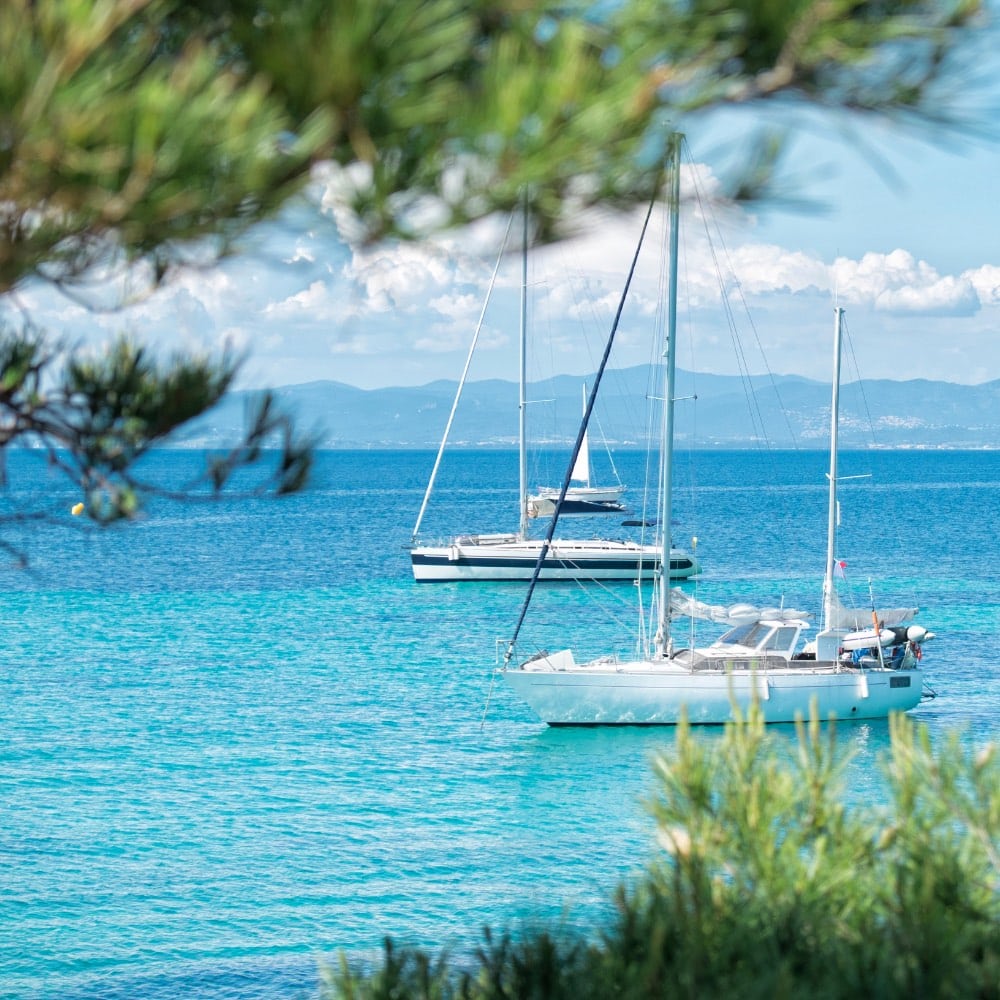
These two islands have in common being defined by their relationship with the sea; it has isolated them, protected them, threatened them, and been traveled across in all directions for sixteen centuries. There is a coherence in approaching them by water rather than by lining up for the ferry.
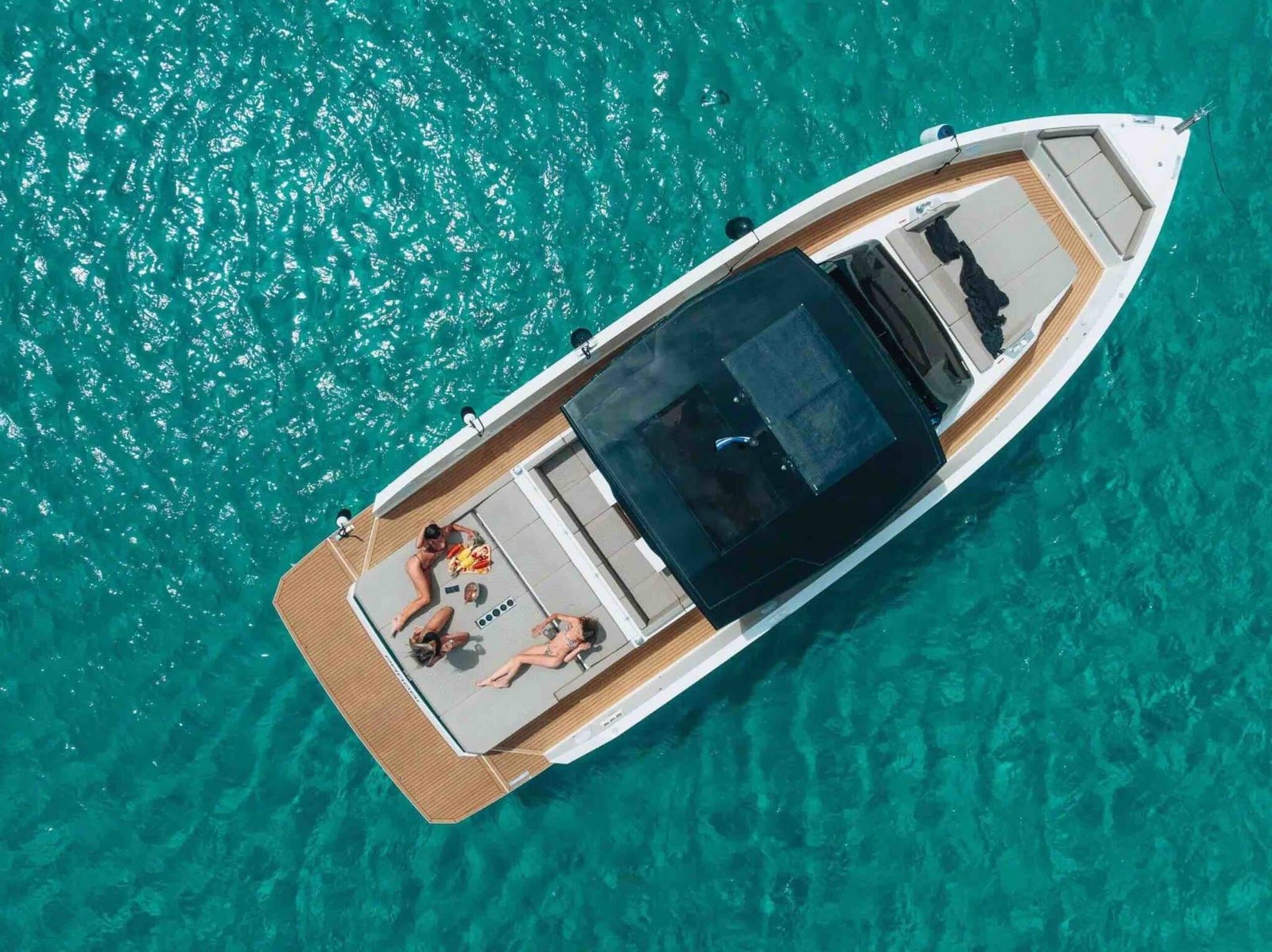
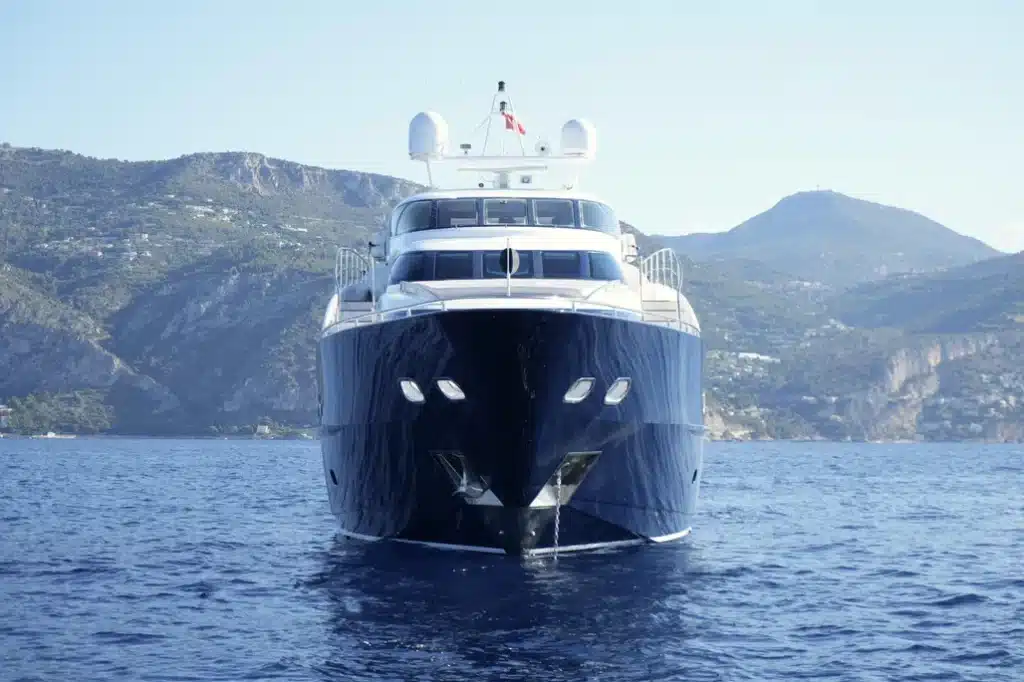
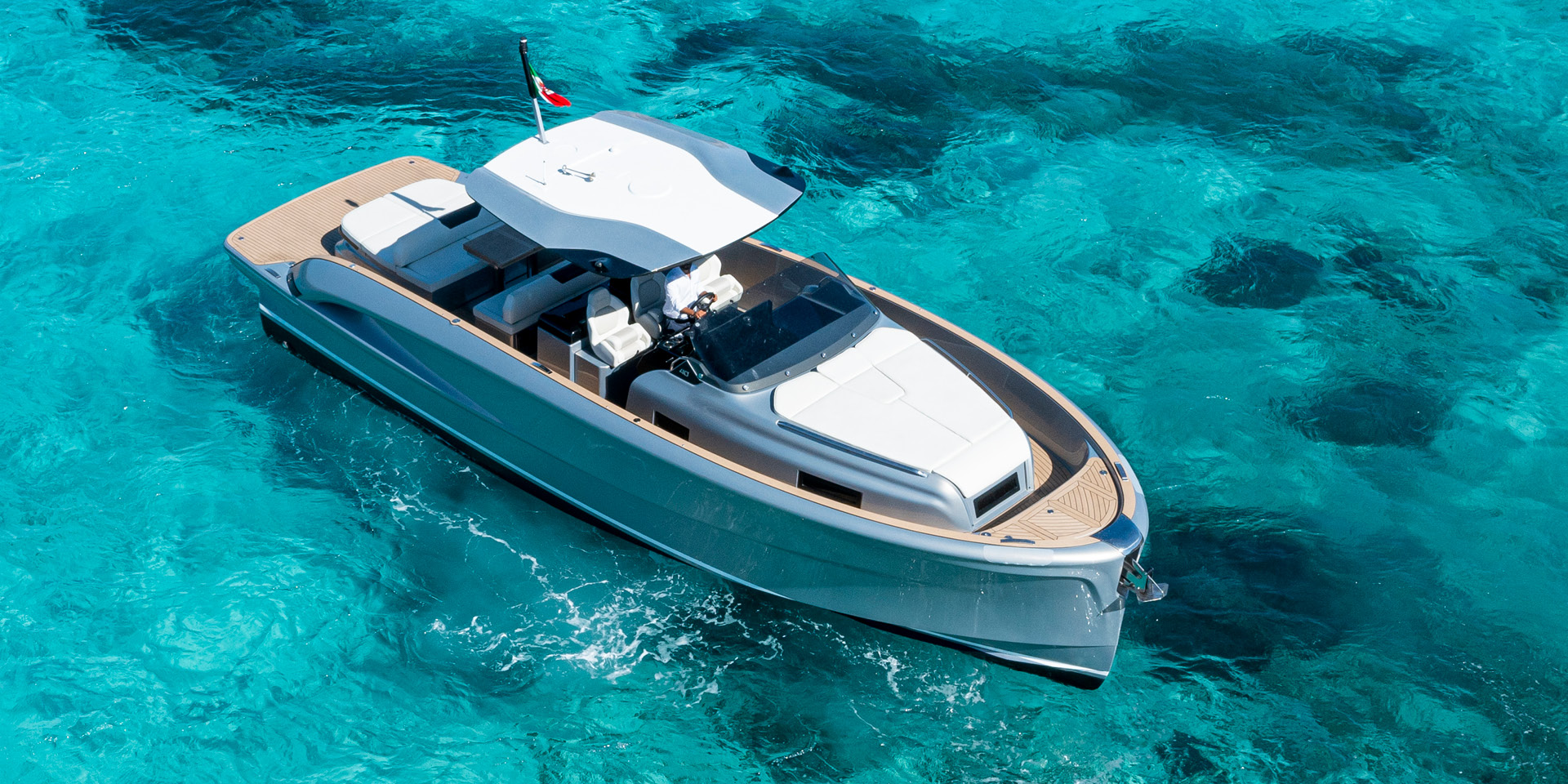
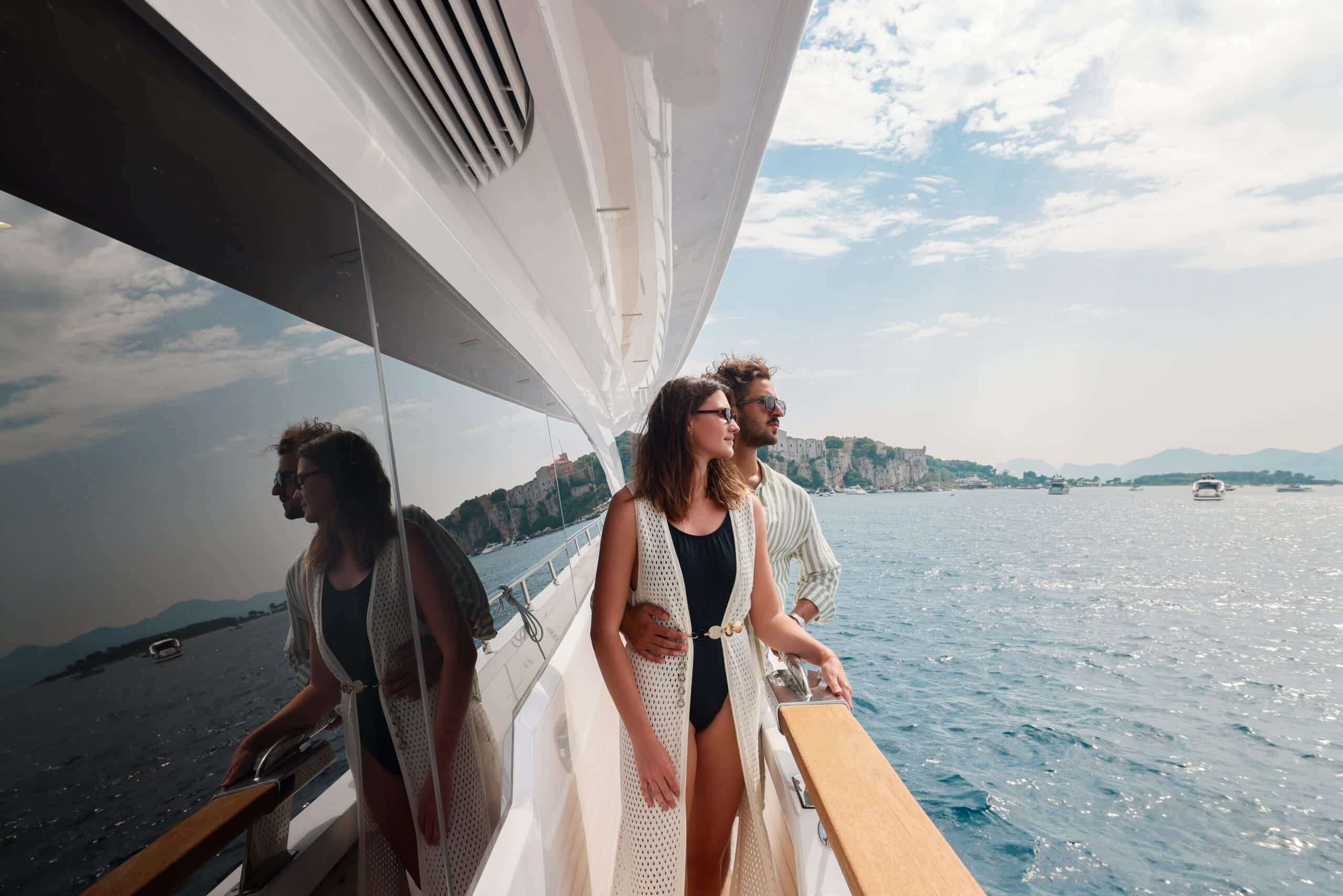
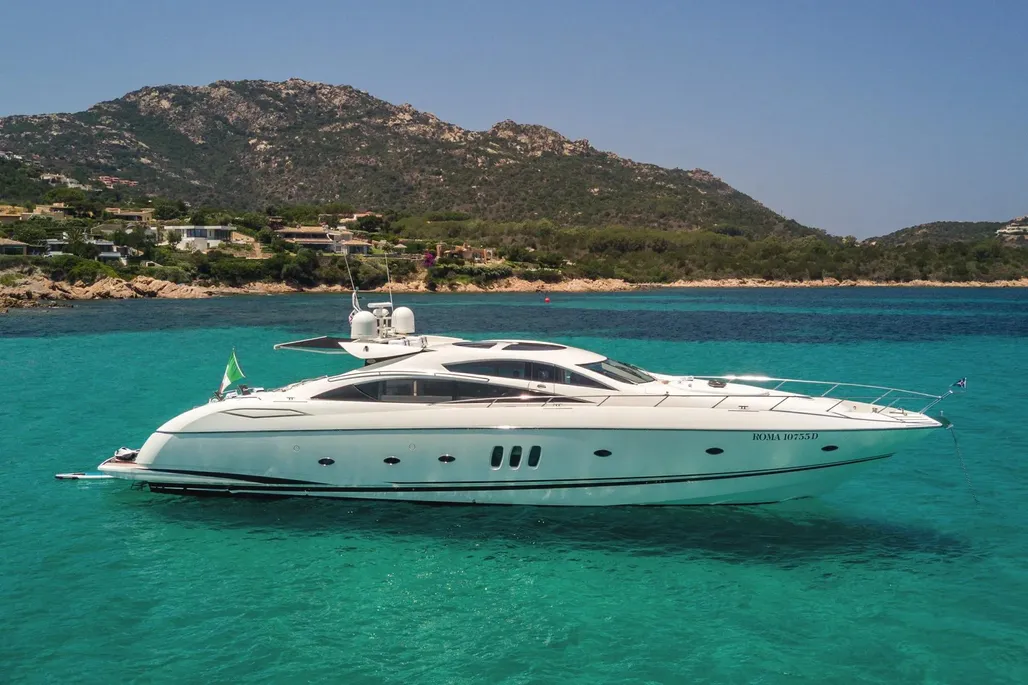
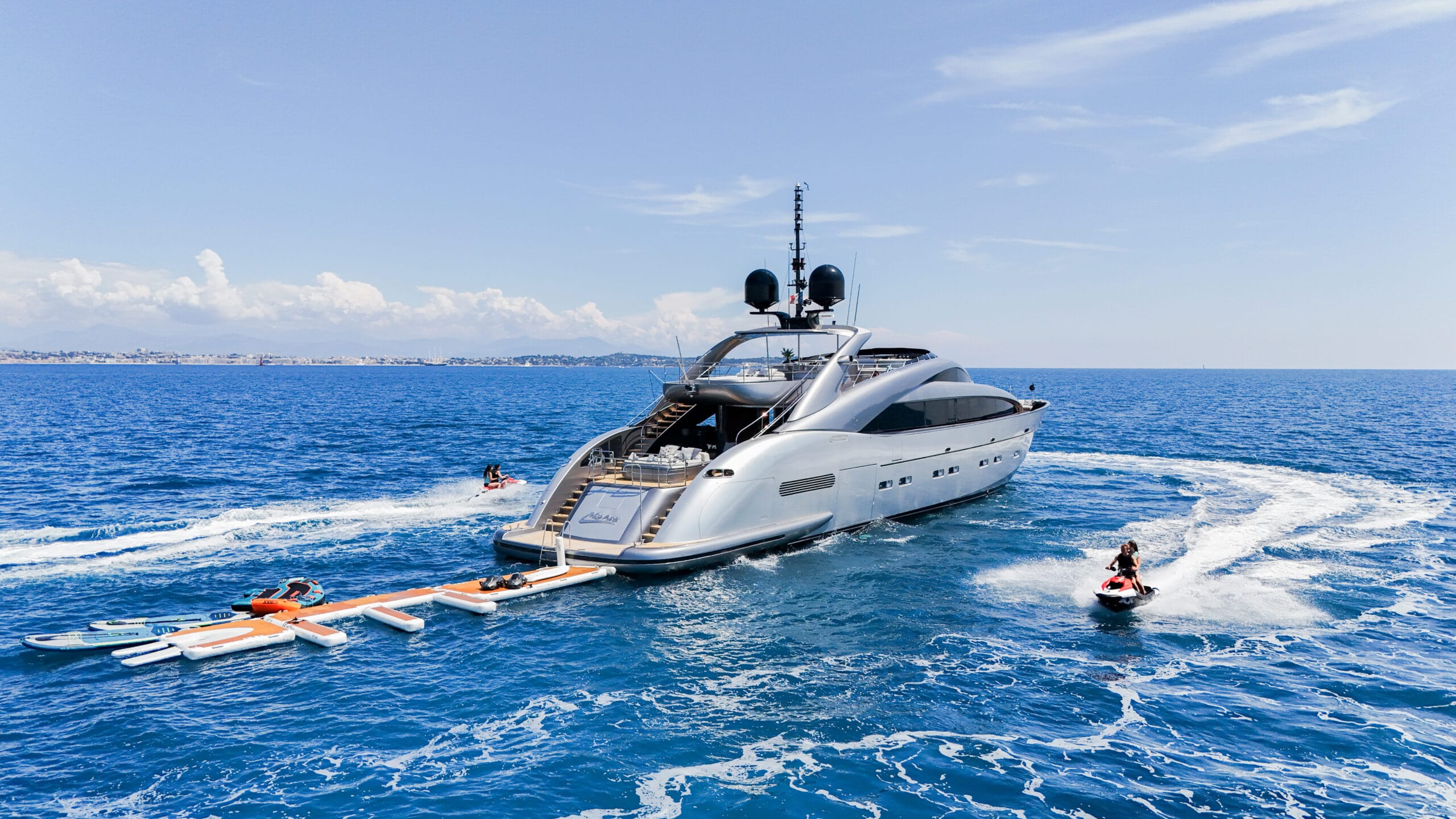
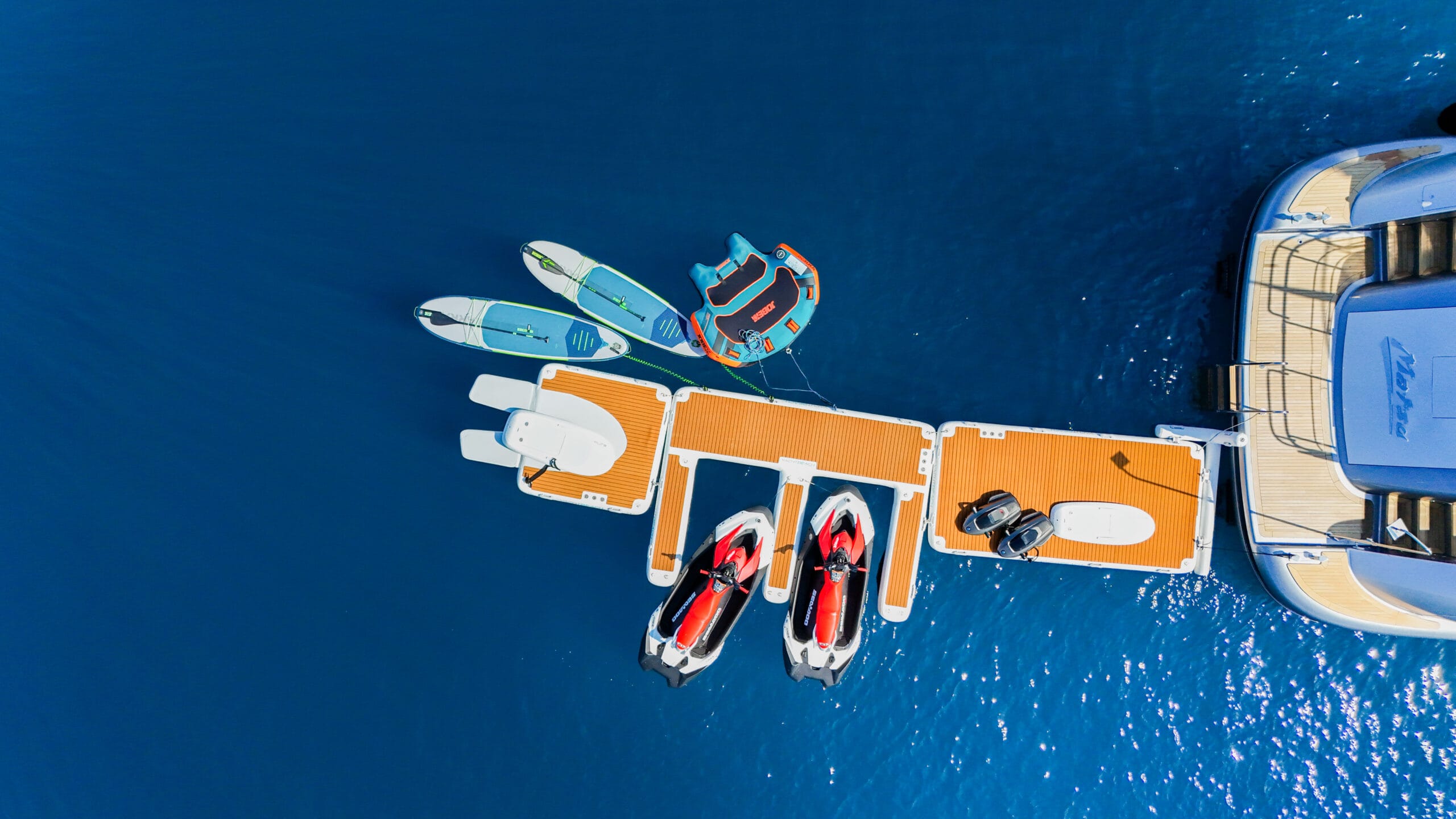
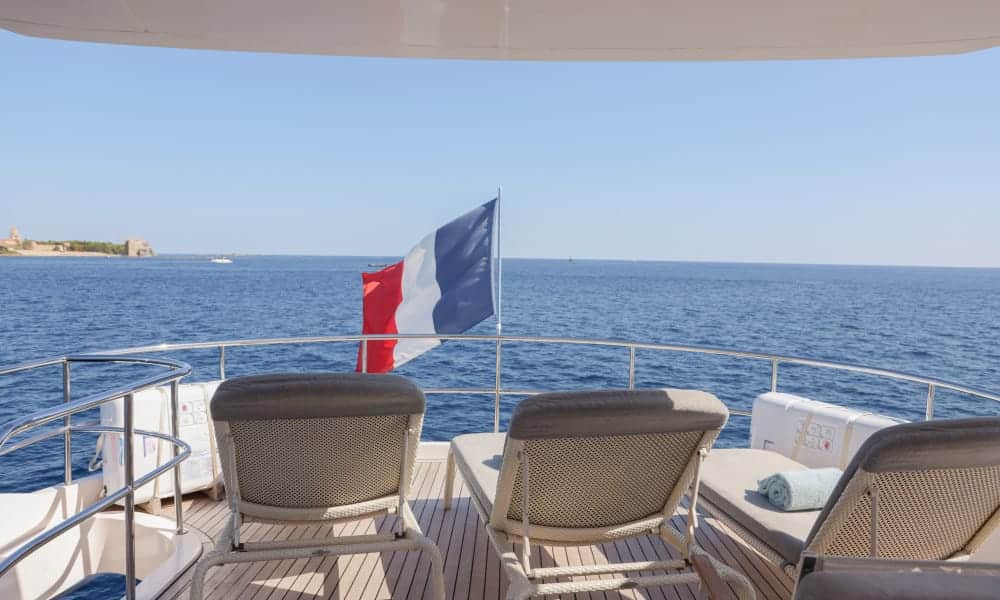
The ferry from Cannes operates on a fixed schedule: group departure, mandatory return, and no ability to navigate freely between or around the two islands. In July-August, the queue to board regularly exceeds an hour. With a private yacht from Cannes, the logic is different. You get wet facing the Royal Fort, go down by dinghy or paddleboard, visit the cell, then head directly back to Saint-Honorat with a ten-minute sail through a calm channel. You have lunch at anchor, swim in coves accessible only by sea, and leave whenever you want. Both islands in the same day, at your own pace, with no one else on the boat.
The’Itinerary Cannes – Lérins Islands – Cap d'Antibes is one of our most requested itineraries. Fort Royal in the morning, anchor in a cove on Sainte-Marguerite at noon, Saint-Honorat in the early afternoon, return to the Bay of Antibes at the end of the day. For those who want to have lunch ashore, La Guérite, a restaurant on Sainte-Marguerite accessible only by sea, remains one of the best tables in the Bay of Cannes. Our captain handles docking.
| Format | Duration | Ideal for |
|---|---|---|
| Half-day Lérins Islands | 4 hours | Visit to Fort Royal + swimming Sainte-Marguerite |
| Full day | 7-8 hours | The two islands + lunch La Guérite + Cap d'Antibes |
| Sunset from the islands | 3 hours | Departure 7 PM, anchor facing the fort, return after sunset |
FAQ – Lérins Islands
Can Fort Royal be visited freely?
Yes. The Iron Mask Museum and Fort Royal is open to the public without prior reservation. The prisoner's cell is accessible. Allow 1.5 to 2 hours for a complete visit, including the underwater archaeological collections.
Can we enter the Abbey of Saint-Honorat?
Partially. The monastery is a living community, with 21 monks residing there. The shop, a part of the cloister, and the church are accessible. The vineyard and the monks' living quarters remain closed.
What's the best time to visit the islands by boat?
May and June are ideal: calm seas, uncrowded coves, excellent light. July and August remain beautiful, but Sainte-Marguerite becomes crowded during the day. On a private boat, you can access anchorages inaccessible to ferries and avoid tourist crowds.
How long does it take to get to the islands from Cannes by boat?
15 to 20 minutes from Port Canto depending on the boat. Sainte-Marguerite is the closest. Saint-Honorat is an additional 10 minutes away. Both islands can be visited in the same day without time constraints.
Who was the Man in the Iron Mask?
The question officially remains unanswered. Modern historiography leans towards Eustache Dauger, implicated in state secrets dangerous to the Crown. The king's twin brother, Dumas' version, is a literary invention. The mask was velvet, not iron. The cell overlooked the Bay of Cannes. The identity, however, is probably lost forever, erased as methodically as the rest.
Reserve your day on the Lérins Islands
Two islands, a royal prison, a thousand-year-old abbey, an Irish saint, five hundred massacred monks, and a nameless prisoner. All of this fifteen minutes from La Croisette. Seen from the sea, with the time it takes, the Lérins Islands have another dimension.
Discover the available boats for the Lérins Islands
See also: All our itineraries on the French Riviera · What is a day on a yacht like?