
From the road that skirts Cap Ferrat, you see almost nothing. Trimmed hedges, wrought-iron gates, discreet surveillance cameras. A few bronze plaques that give no indication. That is precisely the point.
Saint-Jean-Cap-Ferrat is the Riviera’s best-kept secret. It is one of the most expensive towns in France, with prices reaching 60,000 euros per square meter in the most sought-after locations. Five hundred villas account for 80% of the town’s built-up area. From land, everything is hidden. From the sea, the walls disappear.
1905: Rothschild defeats the King of Belgium
The peninsula's story begins with a race. In 1905, Baroness Beatrice de Rothschild learned that King Leopold II of Belgium was eyeing a seven-hectare plot of land at the summit of Cap Ferrat, a rocky and arid promontory, seemingly of little value, but with an exceptional position: both bays of the peninsula visible from the same point.
She buys without bargaining. The king walks by.
Between 1907 and 1912, she had the Villa Île-de-France, now known as the Villa Ephrussi de Rothschild, built on this land. It is a villa in the Italian Renaissance style with nine themed gardens, including a French garden facing the Mediterranean like the prow of a ship. The baroness, who had sailed on passenger ships, wanted to feel like she was at sea from her living room. She had her gardener dressed as a sailor. Upon her death in 1934, she bequeathed the villa and its collections to the Academy of Fine Arts.
Leopold II, for his part, will console himself with other properties on the Riviera. But he will never have Cap Ferrat.
What the walls hide
After Rothschild, others came. Charlie Chaplin, Elizabeth Taylor, Jean Cocteau, Matisse, Chagall, Picasso - over the course of the 20th century, Cap Ferrat attracted a constellation of names who shared only one thing: a taste for the unseen.
Paul Allen, co-founder of Microsoft, owned Villa Maryland there, one of the largest properties on the peninsula. Private concerts are said to have been held in the gardens, with artists like U2 or Prince. This kind of party doesn't appear in any social chronicles. That's the point.
In 2019, Villa des Cèdres, 18,000 square meters of land, one of the most remarkable estates in the town, was sold for over 200 million euros to a Ukrainian billionaire. It was one of the most significant private real estate transactions ever made in France. It didn't make much of a stir.
What the sea reveals
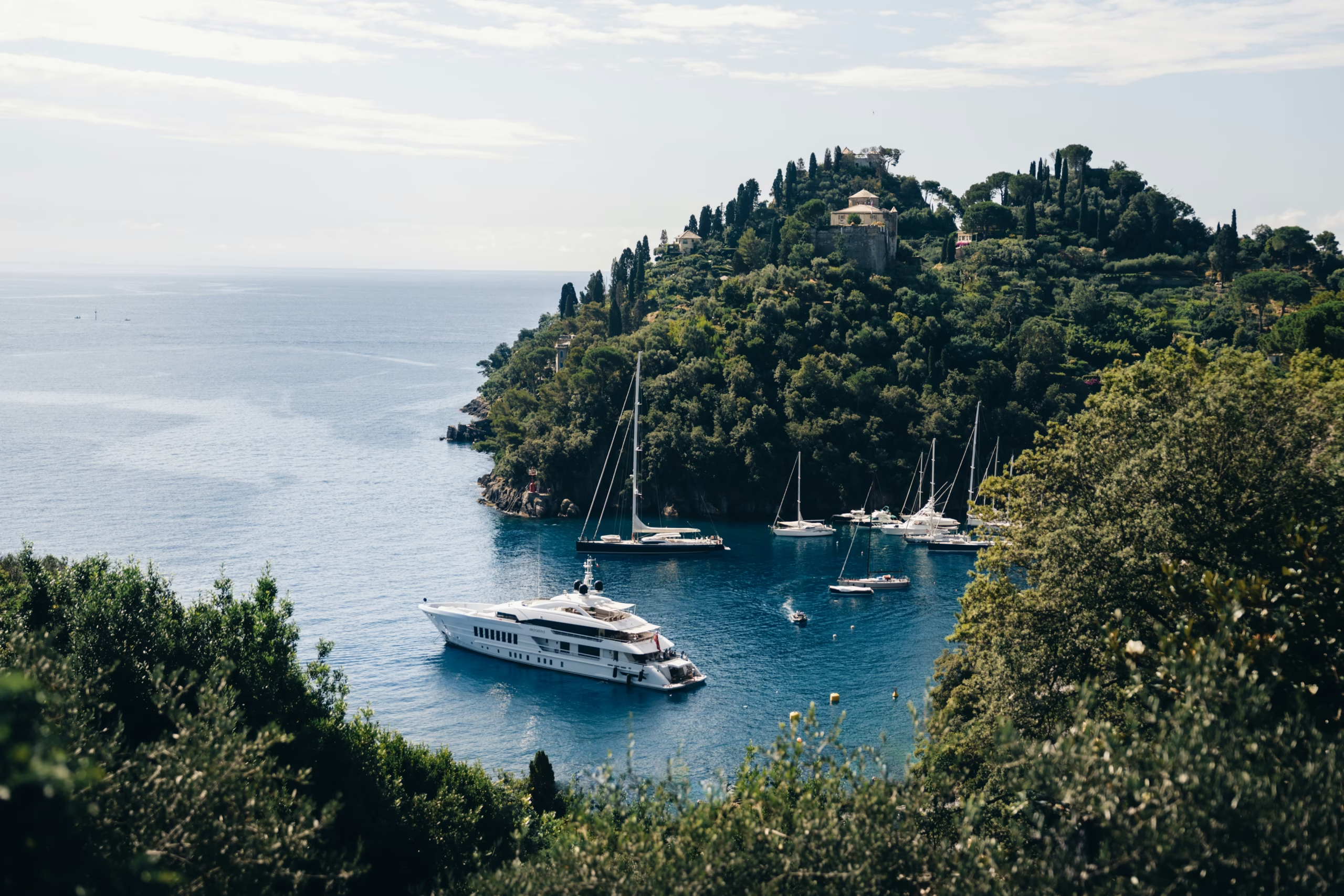
From a boat sailing along the peninsula, Cap Ferrat becomes recognizable. The villas appear in their true context: gardens cascading down to the rocks, terraces opening directly onto the sea, terraces that extend the horizon. What the hedges and gates conceal from the road is entirely visible from the open sea.
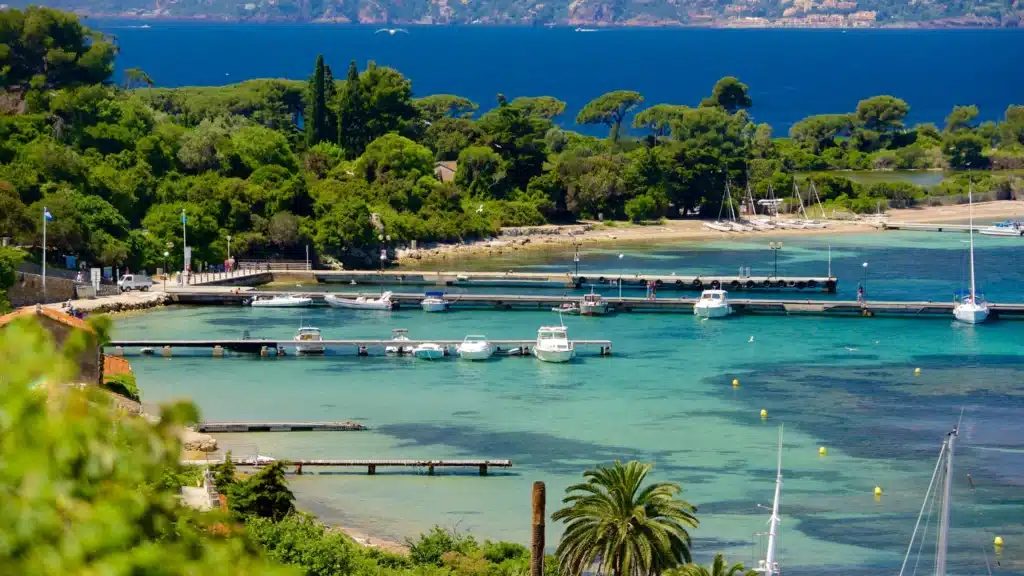
The Saint-Jean-Cap-Ferrat peninsula juts out into the sea between Villefranche and Beaulieu-sur-Mer. From a boat, you can circumnavigate it completely: the west coast, more exposed, with its cliffs and secluded coves; the east coast, more sheltered, with the Saint-Jean marina and the anchorages facing Beaulieu. Two faces for one peninsula.
The water is among the clearest in the area. The geology of the cape, with rocks dropping directly into deep sea, creates exceptional visibility conditions. This is one of the reasons the owners chose this peninsula: from their terraces, they can see the bottom.
Saint-Jean-Cap-Ferrat on a boat itinerary
Cap Ferrat is naturally integrated into navigation between Villefranche and Monaco, one of the busiest routes on the Riviera. From Cannes or Golfe-Juan, you sail past Cap d'Antibes, go by Nice, enter the harbor of Villefranche, and then Cap Ferrat immediately appears to the southeast, its tip jutting out towards the sea, recognizable by its lighthouse.
The anchorage off the east coast, in the bay of Beaulieu, is one of the quietest in the area: sheltered from the prevailing wind, not very crowded, with a direct view of the villa gardens. In high season, when the coves of Cap d'Antibes begin to fill up, Cap Ferrat remains surprisingly calm from offshore. Even during peak season.
Our skippers include Cap Ferrat in the itineraries departing from the Nice – Monaco zone, especially on the course Nice – Villefranche – Monaco. It's often the midday stop, the one we hadn't planned for and that we end up extending.
From the sea, you see what the road doesn't show. The villas, the gardens, the real scale of what the Riviera has accumulated behind its walls. And as you sail along the peninsula, you understand why Beatrice de Rothschild didn't give Leopold II time to think.
Discover Saint-Jean-Cap-Ferrat from the sea
Departing from Monaco, Cannes, or Golfe-Juan, with a skipper.
FAQ – Saint-Jean-Cap-Ferrat by Boat
Can you swim in front of Saint-Jean-Cap-Ferrat?
Yes. Several anchoring areas are accessible around the peninsula, notably off the east coast in Beaulieu cove. The anchorage is quieter than in busier areas like the Lérins Islands during high season, with particularly clear water thanks to the cape's geology.
Why is Saint-Jean-Cap-Ferrat so expensive?
The combination of three factors: extreme land scarcity (the peninsula is entirely built up, with no available land), an exceptional geographical location between Nice and Monaco, and an ultra-wealthy international clientele that has passed down addresses for over a century. Prices reach 60,000 euros per square meter in the most sought-after locations, making it one of the most expensive communes in France.
The history of the Villa Ephrussi de Rothschild is as follows:
The Villa Ephrussi de Rothschild was built between 1907 and 1912 by Baroness Béatrice de Rothschild, who purchased the land in 1905, notably to buy it before King Leopold II of Belgium, who was also interested. The villa, in Italian Renaissance style, includes nine themed gardens, one of which is oriented in the shape of a ship's prow facing the sea. Upon her death in 1934, the Baroness bequeathed it to the Académie des Beaux-Arts, which turned it into a museum open to the public.
How to reach Saint-Jean-Cap-Ferrat by boat from Cannes?
Between 1 hour 15 minutes and 1 hour 45 minutes from Cannes or Golfe-Juan, depending on the boat and sea conditions. The navigation follows the coast of Cap d’Antibes, passes Nice, enters the bay of Villefranche, and goes around the tip of Cap Ferrat. It is one of the most visually rich itineraries on the Riviera, with each cape revealing a new stretch of coastline.