



In 1981, in the Bay of Saint-Tropez, two boats decided to race. The prize: a bottle of champagne. The winner was forgotten almost immediately. What began as a friendly challenge at the end of a day of sailing has become, forty years later, one of the most beautiful regattas in the world.
Every late September, Les Voiles de Saint-Tropez brings together several hundred sailboats in the gulf. It's not a boat show. Nothing is static. Everything moves. And from a boat anchored in the gulf, the sight of 300 spinnakers unfurled simultaneously is unparalleled on the Riviera.
Signac, the light, and the arrival by sea
Saint-Tropez didn't become Saint-Tropez by chance. In 1892, the painter Paul Signac was sailing from Marseille when he stopped in this small fishing village. The light, very particular in this southern-facing open gulf, between the Maures and the sea, captivated him. He never left. He built a studio there and invited other artists. Matisse came in 1904, as did Bonnard, Derain, and Cross.
Signac arrived by sea, and it was from the sea that he painted the port, the sailboats, the «pointus» (traditional wooden fishing boats). What Brigitte Bardot transformed in 1956 with "And God Created Woman," attracting magazines and celebrities, was a town that artists had already colonized for sixty years. Saint-Tropez was maritime before it was glamorous. It is this ancient culture that also explains why one of the most beautiful regattas in the world was born here rather than elsewhere.
1981: The champagne bottle that created a regatta
In September 1981, the crews of the Swan 44 Pride and the 12-meter Ikra launched a friendly challenge in the gulf. The stakes were a bottle of champagne. The race was impromptu, from Club 55 to the offshore buoy, which the locals called the Nioulargue. The winner would be forgotten. The idea, however, would never disappear.
The following year, other boats wanted to participate. Then others still. The event took the name of its marker buoy: La Nioulargue. In 1999, it was renamed Les Voiles de Saint-Tropez to reflect its international scope. Today: several hundred boats, two main categories, classic sailboats before 1976, modern racing sailboats, and a week during which the entire gulf becomes a patchwork of sails. The champagne bottle has aged well.
What makes the Veils different
The Monaco Yacht Show Showcases superyachts. The Cannes Yachting Festival Quay-side boats are presented. Les Voiles de Saint-Tropez features racing sailboats. The difference is fundamental: the boats move. They leave in the morning and return in the evening. In between, the Gulf of Saint-Tropez becomes a racecourse about fifteen kilometers wide.
The classic category is what makes the event visually unique. Boats built in the 1920s, 1930s, and 1950s, with wooden hulls, vintage rigging, and hull lines that are no longer built today. These are not museum pieces: they still sail just as they were designed to sail. Some were built before World War II and continue to race every year. In the thick of the race, spinnaker out, in the Gulf of Saint-Tropez in late September, they possess a beauty that photos cannot truly capture. You have to be there, on the water, to understand it.
The Gulf of Saint-Tropez from a boat
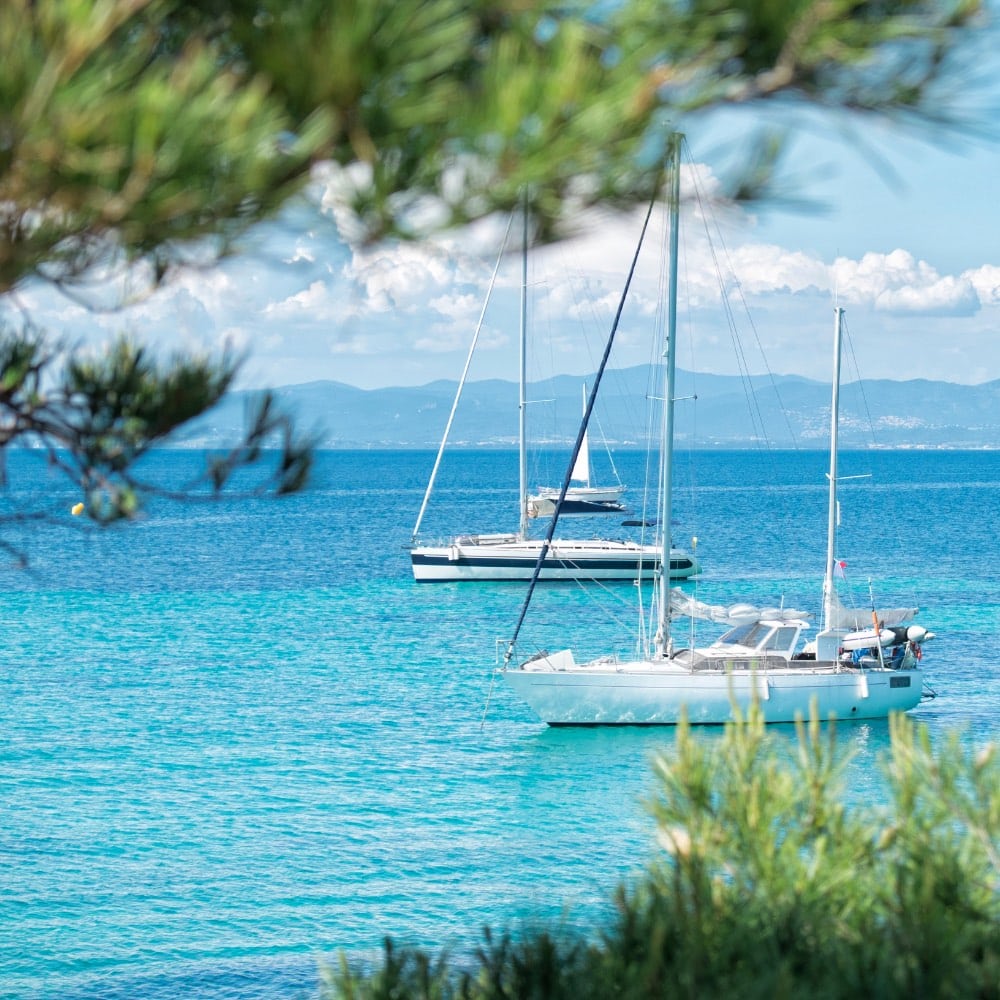
The Gulf of Saint-Tropez is one of the largest on the Riviera, nine kilometers in diameter, sheltered by the Massif des Maures to the north, and open to the sea to the south. In late September, the afternoon thermal winds still enter the gulf, strong enough to fill sails without making the sea rough. Steady thermal winds, still warm seas, and autumn light that sets early behind the Maures: conditions are generally perfect for racing and for spectators. During Les Voiles, the gulf is divided between the race course and spectator areas, accessible to passing boats within regulatory limits.
From a boat anchored in the gulf, the experience is radically different from being at the quay. Ashore, from the Place des Lices or the pontoons, you see the town and a few sails in the distance. From the open water, you are in the midst of the scene: spinnakers drift by a few hundred meters away, classic yachts glide almost silently, modern ones whistle in the gusts. At the end of the day, the sailboats return under shortened spinnaker, the sun setting behind the Maures mountains. For a few minutes, the entire gulf turns orange. The return of the classic yachts to the port is almost more beautiful than the race itself.
Sails on a route from Cannes
Saint-Tropez is forty miles from Cannes. From Golfe-Juan or Cannes, the road follows the entire Esterel cornice from the sea, red cliffs dropping into the blue, one of the most spectacular coastal passages in the Mediterranean, before tilting into the gulf from the south.’Saint-Tropez, Gulf, and Esterel Itinerary covers exactly that route.
One day is enough for a round trip with time in the gulf during the races. The logic: leave early, be in the gulf for the first maneuvers of the morning, stay to watch the boats return to port in the early afternoon, then head back to Cannes with the Estérel as the backdrop for the return journey.
→ Organize your day at Les Voiles from Cannes or Golfe-Juan
Attend the Sails from the Gulf
Departing from Cannes or Golfe-Juan. Two hours of sailing, with the Gulf of Saint-Tropez as a backdrop.
FAQ - Voiles de Saint-Tropez 2026
When are the Les Voiles de Saint-Tropez 2026 held?
Les Voiles de Saint-Tropez is held annually from late September to early October, lasting about ten days. The 2026 edition is expected to take place around the last week of September. The official dates are confirmed by the Société Nautique de Saint-Tropez (SNST) during the year.
What is the origin of Les Voiles de Saint-Tropez?
Les Voiles de Saint-Tropez was born in 1981 from a challenge between the crews of the Swan 44 Pride and the 12 Meter Ikra, for a bottle of champagne. The impromptu race, from Club 55 to the offshore buoy that the people of Saint-Tropez called La Nioulargue, became a tradition, then an international regatta. In 1999, it took its current name. Today, several hundred sailboats participate.
Can one watch the Voiles de Saint-Tropez from a boat?
Yes. The Gulf of Saint-Tropez is accessible to spectator boats during Les Voiles, in areas defined by the organizers outside the active race zone. From a boat anchored in the gulf, the view of the classic sailboats and spinnakers is incomparably better than from the docks. It's the best way to experience the event.
What is the difference between classic and modern sailboats at Les Voiles?
Classic sailboats are boats built before 1976, or with traditional lines and materials, wooden hulls, vintage rigging, and classic waterlines. They represent the most visually spectacular category: boats between 50 and 100 years old that are still racing. Modern sailboats are contemporary racers, technically more performant but visually less rare.
What is the distance between Cannes and Saint-Tropez by boat?
Around 40 nautical miles, or two hours of sailing from Cannes or Golfe-Juan depending on the boat and conditions. The route follows the Esterel coastal road, one of the most beautiful coastal passages in the Mediterranean, before entering the Gulf of Saint-Tropez from the south. A round trip in the same day is entirely feasible.